Hurvin Anderson at Tate Britain
Hurvin Anderson selected Black Audio Collective’s 1986 documentary Handsworth Songs about the 1985 Handsworth Uprising to accompany his expansive Tate Britain retrospective. The film shows inner-city Birmingham riven with racial division and political unrest, snapshots of a Britain beset by ‘Fear of Otherness’, so described in the professionally modulated, silken, if entirely unsympathetic comments of then Prime Minister, Margaret Thatcher.
The community marches, bearing placards and home-sewn banners protesting a meeting of the National Front. The far-right organisers enter, flanked by rings of police. Rastafari make impassioned calls for justice that is still a long way off. Black and Asian community leaders relay shared frustrations about lack of opportunity, lack of jobs, lack of hope. Finally, a stinging reminder of a slur-ridden 1964 Conservative Party slogan prompts every viewer to shift uncomfortably on the benches.
This was the grim, but not so distant backdrop to Anderson’s show, spanning a career of over four decades and featuring more than 80 paintings. The choice of film bears out thematically, with vast, oppressive buildings scattered throughout each room of the seven rooms, their brutal shapes washed out in sharply delineated blocks of watery grey.
Neuroscientific studies suggest that every time you revisit a memory, your current emotional state will tint the event, overlaying it with whatever you are feeling at the time of revisiting. That layer makes imperceptible changes to the memory, so that in time, it will shift like a shell on the seabed, lifted by waves that care nothing for its original landing place.
This is the notion lapping at the shores of my mind throughout, observing how Anderson slices and dices theme and process: layering, removing, transposing old photographs and contemporary landscapes with imagined figures, invented places, cultural narratives, shared histories, political malfeasance and family memory. A video of the artist walking viewers through a complex set of physical processes in his studio shows him blend screen printing, photography and collage to arrive at the final layout of these vast, lush paintings.
Opening with a room of muted studies, Anderson's sister Bev barely emerges from the monochrome background, offered in the flat, lifeless sepia of decades’ old photographs. Stern paternal eyes peer out from Hollywood Boulevard, a poster of the first Black cowboy separating father and son. A reassuring smile nods to the distant family across the ocean that “All is well here”, with a hand on the box TV, in front of the patterned curtains of a comfortable living room.
Opening out to the next room, one feels the vast contrast between the flat, joyless grey of Birmingham’s backstreets and the giant, bleached swathes of lemon, acid washes of cobalt blue, vibrant taches of vermilion, orange, lime, hot pink that characterise the giant twenty-four-panel Passenger Opportunity. Here is Anderson's manifesto: the fraught hopefuls of the Windrush generation proudly making their way to a new life in their Sunday best, shown side by side with the scars of a brutal heritage in bondage, their ancestors' necks and feet bound in iron, tramping across the lower right corner.
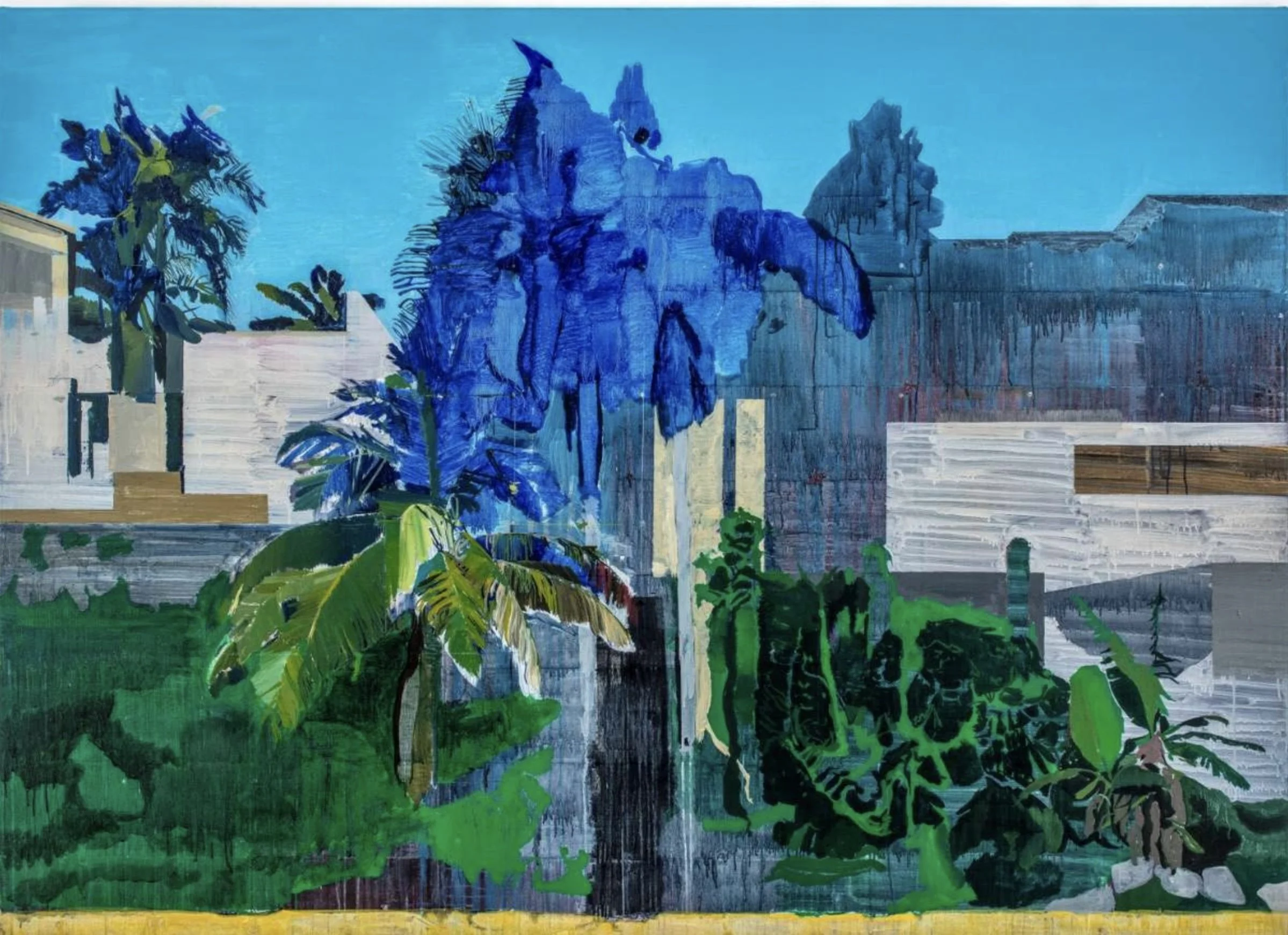
Anderson's instinctive understanding of paint allows for an enormous range of mark-making. From oppressively dense green vegetative walls bearing down on the horizon line of the beach to a palm-fringed, inky pool, drawing one deeper into the centre of the painting, beyond the long spines of the palm trunks that cut straight down the canvas, their spindly leaves creating a canopy under creamy yellow sunlight. Domestic scenes are festooned with bright wallpaper prints, tender reproductions of orange and yellow checkered fabrics are draped around shoulders awaiting clippers in Peter's Sitters II. Folds of a sarong are sketched with a stroke of a rag that you can feel the artist making only a moment ago, then going back to add two or three solid blocks of colour. Later, in the Salon series, one can stand spellbound before Anderson’s Barbershops for fifteen minutes by the intricate, richly rendered A5 portraits of Martin Luther King Jr and Malcolm X. Their likenesses lift them up and out for veneration, raised from a pond of smaller black and white paintings within the painting: black boxes with ghostly hints of Mohammad Ali's boxing gloves floating above salon bottles, combs, shaving brushes, clippers, looming up in a white wash from the side of the salon mirror.
Otherness takes many guises in these richly atmospheric paintings. Anderson suspends us between his homelands in a technicolour limbo: the action is happening through a grille blocking us from the cityscape, a tennis court lies beyond the chicken wire covering the whole surface of the painting: fences, wires, cables, reflections in mirrors all separate us from the scene. Hard red lines slice up the Trinidadian city view behind intricately designed iron grilles in the Port of Spain. Delicate clouds of leaf-starlings undulate over spiderwebbed telephone wires in Imperial. Yet these barriers are meaningless to the lush vegetation breaking through the imperial gloom: huge tropical leaves fan out joyfully over concrete blocks of ugly hotels, their roofs and tourist balconies overrun, rebellious sprays of bright flowers and vines cascade over fences, demanding admission.
Yet, again and again, Anderson removes us to his side: like him, we cannot cross fully into either world, populated as they are by groups of figures three or four inches tall, who disintegrate up close.
Posing pin-ups are nothing more than popped hips and triangle bikini tops conjured by the flick of a wrist. Swimmers splashing in the indoor pool of Audition are causally articulated in confident, meandering strokes, half buried in a foamy splash, expertly constructed with hundreds of whispy white lines. The spray proffers an ankle, its delicate outline trailing off like an unfinished sentence. Anderson describes a community at leisure in Jamaica, yet only half-acknowledged and almost universally disrespected by their colonisers, a nation with the gall to invite his family to build Britain’s roads, staff Britain’s hospitals, conduct Britain’s buses, and be beaten, maligned and abused for their efforts.
Anderson’s show presents all the political and aesthetic ugliness of Black Birmingham in the 1980s, giving way to a rich, delicately assembled vision of Carribbean culture, memory and imagination. It is hard not to be haunted by the darkness of Britain's slave-trading past washing through the rooms, with four new paintings made especially for the show - two couples on identical rafts float opposite each other, generations apart, on tides slow to turn, between, a jubilant welcome of Emperor Selassie, and a generation still waiting for change.
Both there and not there, invention and memory collide in this elegy to the vibrant, romantic, sun-drenched Carribbean and yet-to-be answered hopes of Black and Brown Britain.
